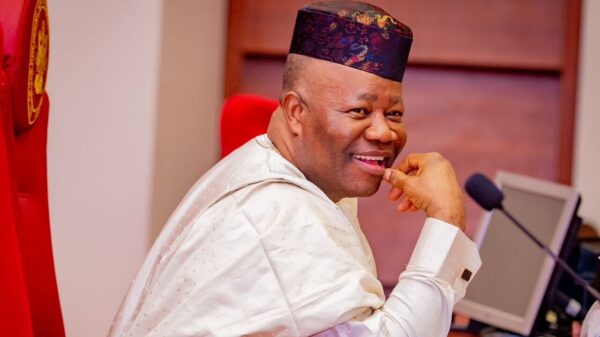
Lawmakers in the upper legislative chamber have declared that the position of the Senate President in the upcoming 11th National Assembly is not vacant, passing an early vote of confidence in the incumbent, Senator Godswill Akpabio.
The stance was made public following a motion moved by Senator Tahir Monguno and seconded by Senator Cyril Fasuyi (Ekiti North), with lawmakers moving to forestall political maneuvering ahead of the next assembly’s inauguration.
Extending their endorsement to Deputy Senate President Barau Jibrin and other principal officers, senators voiced unified support to keep the current leadership structure intact.
“I hereby support the motion ably moved by Senator Monguno that the seat of the Senate President in the 11th Assembly is not open to any contest. It is already occupied by Senator Godswill Obot Akpabio.”
Acknowledging the intense interest usually surrounding leadership seats, Akpabio noted that with executive contests concluded, attention naturally shifts to the legislature.
“I know the position of president is gone, the position of vice president is gone, the only one that is left now is the position of Senate President. So, everybody will want to contest that,” Akpabio remarked, expressing optimism that many current members would return in the 11th Assembly.
Our correspondent reports that while the declaration demonstrates strong political backing, the official election of presiding officers remains subject to statutory legislative procedures when the 11th Assembly is formally constituted.
Beyond the leadership debate, Akpabio cautioned political analysts, television commentators, and panel speakers against taking floor debates out of context to score political points or damage reputations.
He said media commentators should evaluate final Senate resolutions rather than isolated, heated exchanges during debates.
Vigorous debate is a hallmark of lawmaking where members are expected to oppose and support various viewpoints.
Lawmakers warned against misinterpreting sensitive discussions—specifically recent floor debates on reviewing the decriminalisation of suicide—as religious or ideological attacks.
Addressing controversies tied to the suicide debate, Akpabio firmly rejected attempts to link terrorism with any faith, emphasizing that acts of violence and self-destruction violate fundamental religious doctrines.
“Terrorists are not Muslims. Terrorists are not Christians.Terrorists are human beings who believe in taking their lives and the lives of others,’’ Akpabio said.
Akpabio clarified that the legislative intent behind re-examining suicide laws is to differentiate between acts of terror and mental health crises.
He said individuals driven to suicide attempts by severe mental health conditions from violent offenders, reaffirming that major faiths, including Islam, strictly forbid suicide and the taking of innocent lives.
Reinforcing this point, a fellow senator cited Suratul An-Nisa (Chapter 4, Verse 29) of the Quran, underscoring that Islam explicitly prohibits self-destruction and unlawful killing.
The lawmakers stressed that robust debate inside the chamber reflects active democracy at work—and warned against allowing misinterpretations to stoke religious or political division across the nation.
____
Follow us on Twitter at @thesignalng
Copyright 2026 SIGNAL. Permission to use portions of this article is granted provided appropriate credits are given to www.signalng.com and other relevant sources.