


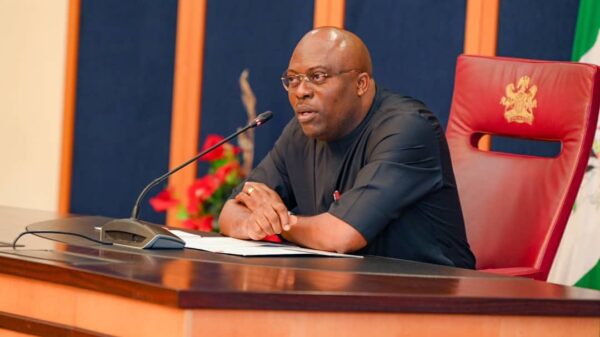
































































































An independent civic watchdog has absolved Siminalayi Fubara, governor of Rivers state, of any wrongdoing, describing the ongoing impeachment proceedings against him and his deputy, Ngozi Odu, as a political witch-hunt driven by personal interests rather than constitutional breaches.
In a statement issued on Thursday by the Good Governance Advocacy Centre (GGAC), the group said a 72-hour forensic review of the impeachment notice and accompanying allegations revealed no evidence of gross misconduct capable of sustaining the removal of the governor or his deputy under the constitution.
The statement, signed by Dr Zaccheus Ocha, country representative of GGAC, said the organisation undertook an “exhaustive legal, procedural and factual analysis” of the issues raised by the Rivers state house of assembly and found them “manifestly weak, speculative and politically motivated”.
According to GGAC, the impeachment letter failed the basic constitutional threshold required to trigger removal proceedings, noting that the allegations were either unsupported by verifiable facts or fell squarely within the discretionary powers of the executive arm of government.
“The Good Governance Advocacy Centre has concluded, after a 72-hour independent review, that there is no act of gross misconduct established against Governor Siminalayi Fubara or his deputy,” the statement reads.
“What is presented as impeachment is, in substance, a political project aimed at personal and factional gains, not the protection of constitutional order.”
The group said its review covered the text of the impeachment notice, relevant constitutional provisions, financial records cited by lawmakers, and public actions of the executive since the inauguration of the administration. It added that none of the claims met the standard of “grave violation or misconduct” envisaged by Section 188 of the constitution.
GGAC also linked the impeachment move to the lingering political feud between the governor and his predecessor, Nyesom Wike, describing the crisis as a continuation of unresolved power struggles rather than a genuine accountability process.
“The pattern of events in Rivers state suggests that the impeachment proceedings are not occurring in a political vacuum,” the statement said.
“Our analysis indicates that the legislative actions against Governor Fubara are deeply rooted in the post-transition power tussle following the exit of the former governor, Nyesom Wike, and the resistance to the governor’s efforts to assert institutional independence.”
The group observed the house of assembly had become “a proxy battlefield” in a broader struggle to retain control over state structures, adding that impeachment was being deployed as a coercive instrument to force political submission.
“Disagreements between former and incumbent political leaders cannot be resolved through the abuse of constitutional mechanisms. Impeachment is an extraordinary remedy, not a weapon for enforcing loyalty or settling succession disputes,” GGAC said.
The advocacy group warned that weaponising impeachment for political vendettas poses a grave threat to democratic stability, not just in Rivers but nationally.
“Our findings show a deliberate attempt to intimidate the executive and destabilise governance in Rivers state through legislative overreach,” the statement said.
GGAC further noted that several allegations cited administrative decisions clearly within the lawful authority of the governor, including appointments and budgetary actions, adding that no court order had been breached and no criminal infraction established.
It also faulted the speed with which the impeachment process was initiated, saying it raised serious concerns about due process and fair hearing. The group said its analysis revealed “clear procedural red flags”, including inadequate time for response and what it described as a pre-determined outcome.
“The rush to impeachment, without sincere effort at dialogue or reconciliation, reinforces the conclusion that the process is punitive rather than corrective,” the statement noted.
The group warned that continuing with the impeachment could plunge Rivers into prolonged instability, distract from governance, and undermine economic and security priorities in the oil-producing state.
It called on lawmakers to immediately suspend the proceedings and embrace dialogue, urging respected political leaders, elders, and civil society actors to intervene to prevent what it described as an “avoidable constitutional crisis engineered by political brinkmanship”.
“Rivers state does not need another season of manufactured instability. The interests of citizens must take precedence over personal ambitions and unresolved political grievances,” GGAC said.
The organisation also urged national democratic institutions to monitor developments closely, stressing that impeachment processes must be guided strictly by law and not by the influence of powerful political actors operating behind the scenes.
“The credibility of Nigeria’s democracy depends on how power is exercised and restrained. When impeachment becomes a bargaining chip in elite power struggles, public trust in democratic institutions is eroded,” the statement said.
The report comes amid heightened political tension in Rivers following the decision of the state house of assembly to commence impeachment proceedings against Fubara and Odu, a move that has drawn mixed reactions from political actors and civil society groups.
GGAC said it would make its full analytical report available to lawmakers, stakeholders and the public, insisting that transparency, restraint and strict adherence to constitutional norms remain the only path to democratic stability.