



























































































































Nigeria’s headline inflation rate declined to 14.63 per cent in September 2026 from 15.39 per cent in August, despite persistent concerns over rising food prices.
The latest report by the National Bureau of Statistics (NBS) showed that headline inflation also fell significantly from 20.98 per cent recorded in September 2025, representing a year-on-year decline of 6.35 percentage points.
According to the report, the month-on-month headline inflation rate dropped to 0.06 per cent in September from 0.71 per cent in August, indicating a slower increase in the average price level during the period.
The NBS explained that the September figure reflected a lower rate of increase in average prices compared with the preceding month.
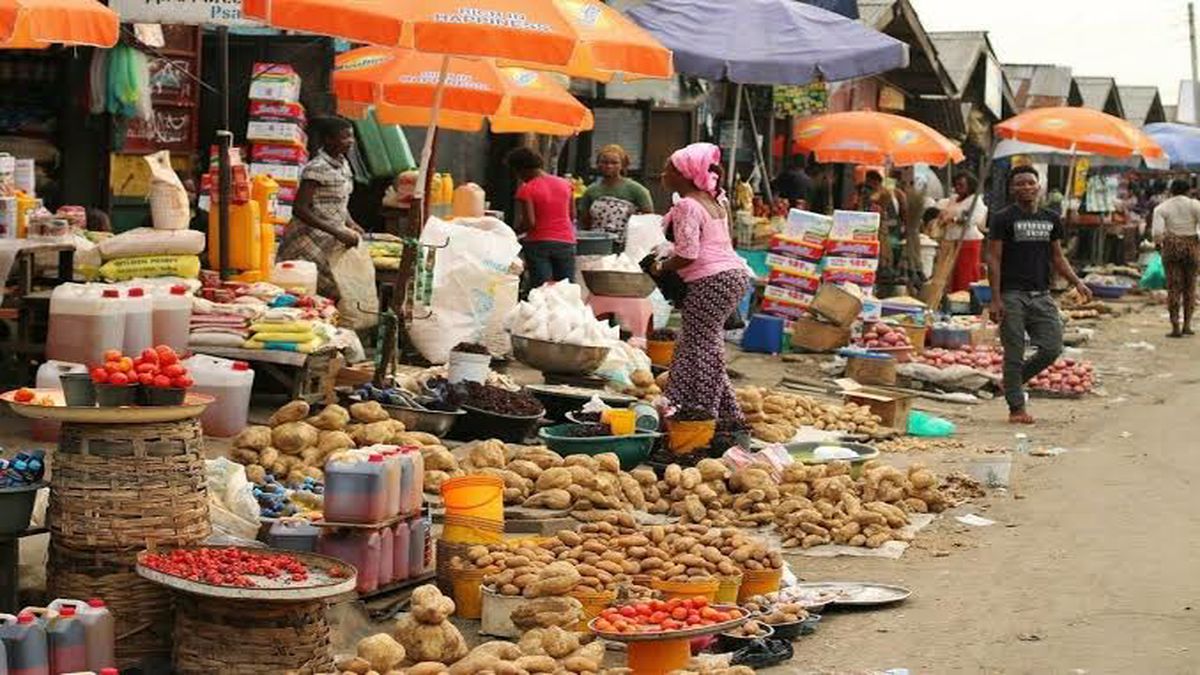
Despite the moderation in headline inflation, food prices remain a major concern, particularly for low-income households, whose spending is disproportionately concentrated on essential commodities, according to analysts.
The report showed that food inflation stood at 19.59 per cent year-on-year in September 2026, compared with 20.16 per cent recorded in the corresponding period of 2025.
On a month-on-month basis, however, food inflation recorded a negative rate of 1.55 per cent, representing a decline of 2.57 percentage points from the 1.02 per cent recorded in August.
The bureau attributed the decline to price movements in several food items, including guinea corn flour, white maize flour, locally produced short-grain rice, eggs, fresh onions, palm oil, green beans, Irish potatoes, okra, fresh tomatoes, dried green peas and plantains.
Meanwhile, the average annual food inflation rate for the 12 months ending September 2026 stood at 15.72 per cent, down from 28.37 per cent recorded in September 2025.
Core inflation, which excludes agricultural produce and energy prices, also declined to 12.95 per cent year-on-year in September, compared with 22.11 per cent in the corresponding period of the previous year.
However, the month-on-month core inflation rate rose to 1.11 per cent from -0.06 per cent in August, suggesting that underlying price pressures persist despite the broader moderation in inflation.
The average annual core inflation rate for the 12 months ending September 2026 stood at 16.54 per cent, compared with 25.68 per cent recorded a year earlier.
The report also revealed significant differences in inflation trends across states.
Imo recorded the highest year-on-year headline inflation at 30.04 per cent, followed by Enugu at 22.38 per cent and Niger at 22.05 per cent. Taraba, Bauchi and Adamawa recorded the lowest rates at 1.78 per cent, 2.84 per cent and 3.66 per cent, respectively.
On a month-on-month basis, Imo recorded the highest increase at 8.64 per cent, followed by Kaduna at 4.46 per cent and Sokoto at 3.01 per cent. Adamawa, Bauchi and Kano recorded declines of 6.10 per cent, 5.31 per cent and 4.49 per cent, respectively.
For food inflation, Lagos recorded the highest year-on-year rate at 34.40 per cent, followed by Imo at 33.79 per cent and Ondo at 31.49 per cent. Taraba recorded -7.47 per cent, Yobe -0.37 per cent and Borno 2.18 per cent.
On a month-on-month basis, food inflation was highest in Imo at 5.15 per cent, Ondo at 4.46 per cent and Oyo at 3.82 per cent. Adamawa, Kano and Bauchi recorded declines of 13.84 per cent, 11.01 per cent and 10.21 per cent, respectively.
…Food inflation remains major threat to households
Commenting on the figures, the Chief Executive Officer of the Centre for the Promotion of Private Enterprise (CPPE), Dr. Muda Yusuf, said food inflation increased marginally from 19.57 per cent in August to 19.59 per cent in September, exceeding headline inflation by 4.96 percentage points.
He said the divergence was economically significant because food accounts for a substantial proportion of expenditure among low-income households.
According to him, elevated food inflation erodes purchasing power, increases poverty risks and weakens household consumption. As families spend more on food, less money is available for manufactured goods, education, healthcare and other services, potentially weakening demand and affecting consumer-facing businesses.
Yusuf attributed persistent food inflation to structural challenges in agricultural production and distribution, including insecurity, inadequate rural infrastructure, high logistics costs, post-harvest losses and inefficient market connections.
He called for targeted supply-side interventions to address these constraints rather than relying predominantly on monetary tightening.
On the broader economic outlook, Yusuf said declining headline inflation offered opportunities for the private sector by improving prospects for interest rates, financial planning and investment confidence.
He noted that the Central Bank’s September reduction of the Monetary Policy Rate by 350 basis points to 23 per cent provided a foundation for further monetary easing, although lower policy rates might take time to translate into reduced commercial lending rates.
He said cheaper financing would benefit capital-intensive businesses, manufacturers, agricultural enterprises and micro, small and medium-sized enterprises.
However, Yusuf cautioned that the increase in monthly core inflation from -0.06 per cent in August to 1.11 per cent in September showed that underlying price pressures had not been fully contained.
He said businesses continued to face a mixed operating environment characterised by improved macroeconomic predictability alongside high energy and logistics costs and weak consumer demand.
Yusuf urged the government to sustain prudent monetary easing while tackling insecurity in farming communities, improving agricultural productivity, reducing post-harvest losses and lowering food distribution costs.
He stressed that declining inflation should not be confused with falling operating costs, noting that sustainable investment and stronger business profitability would depend on addressing the structural challenges confronting the economy.
____
Follow us on Twitter at @thesignalng
Copyright 2026 SIGNAL. Permission to use portions of this article is granted provided appropriate credits are given to www.signalng.com and other relevant sources.